

Charging Electric Cars: The Complete Guide for Beginners
The transition to a sustainable transport system is in full swing: in the first half of 2025, fully electric vehicles (BEVs) reached a market share of 15.6% in the European Union, an increase of 34%, according to the EU Commission. In this context, the charging process for electric cars is becoming an important topic of discussion.
As electric vehicles are adopted, the charging network is expanding rapidly. The number of public charging points increased by more than 35% last year, surpassing 1 million stations in Europe alone, according to the International Energy Agency – IEA.
Charging an electric car efficiently is, therefore, becoming an essential skill. Anyone who wants to drive an electric vehicle without stress needs to understand how to charge. That’s why, in this complete guide for beginners, we’ll walk you through the essential steps. And we’ll understand how and where to charge, how much it costs and how long it takes. So you can enjoy freedom, economy and sustainability without compromise.
Why is it important to understand the charging process for electric cars?
Electric mobility is no longer just a trend. Electric cars are a practical, economical and environmentally friendly alternative to cars with internal combustion engines. And from the adoption rate statistics, although there are still challenges, electric cars are the future.
However, owning and charging such a vehicle is still a new experience for many drivers. And, in some places, challenging. Compared to filling up at a gas station, charging an electric car comes with some unknowns. Which can seem daunting and can trigger emotions even among technology fans.
For example: where do you charge? What does fast charging mean? How do you pay? Which cable fits your car? And many other questions that may come to your mind. Exactly for these, it is important to understand how charging works.
Charging types: AC vs DC, slow, fast, ultra-fast – what are they and how do they work?
Just like your phone or laptop, an electric car needs electricity to run. But unlike small appliances in your home, charging a car battery involves different technologies.
AC vs DC charging – what is it and how does it work?
There are 2 main types of current used to charge electric cars: AC (alternating current) and DC (direct current). And each type of current is suitable for the charging process of an electric car in different contexts.
AC charging (alternating current)
According to BESEN Group, a manufacturer of electric vehicle charging equipment, AC charging is extremely common globally. And it is used in most common locations (offices, home charging, but also at public stations).
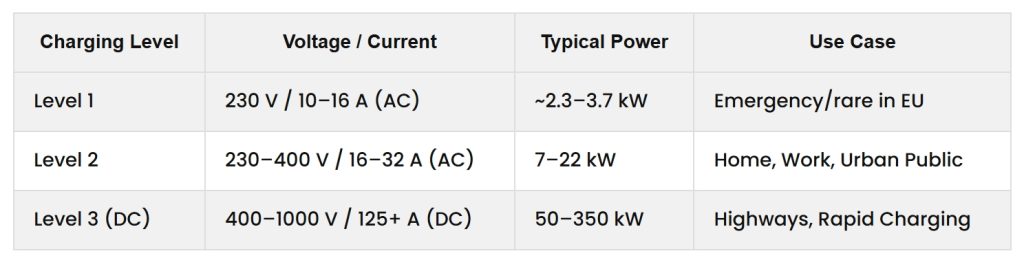
- Power: usually between 3.7 kW – 22 kW
- Where you find it: at home, at the office, in public parking lots
- Charging time: between 4 and 12 hours, depending on the battery and the power of the station
- Standard connector in Europe: Type 2
🏠This option is ideal for charging overnight or during work hours.
At EV SPOTS you can find a lot of 22kW AC stations. See here: 22kW stations.
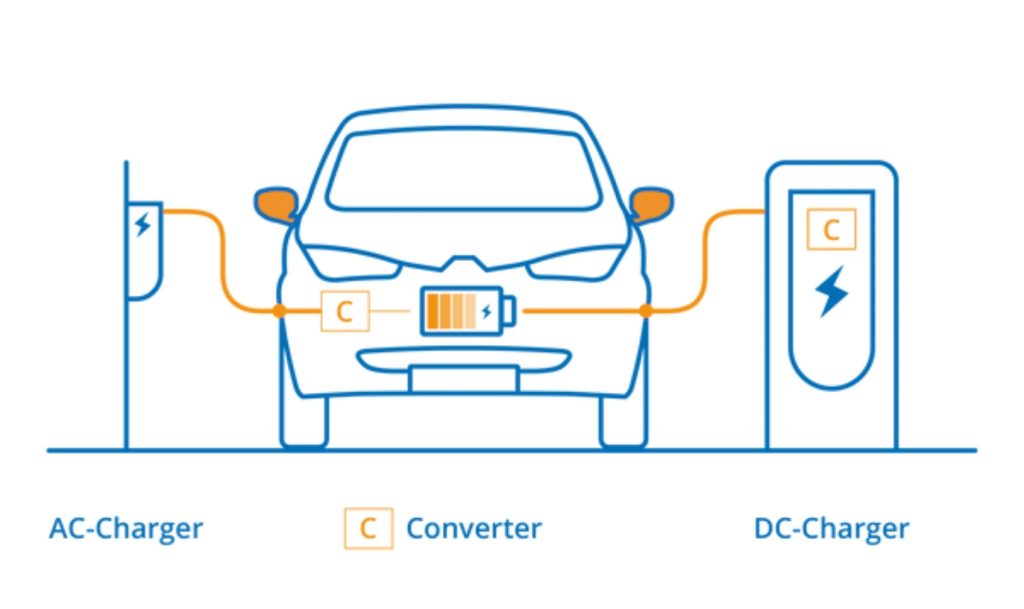
Your EV receives energy from the station in AC form, and the current conversion (from AC to DC) is done inside the car (via the onboard charger). This is one of the main differences between AC and DC. You can see a diagram of this in the image below.
DC charging (direct current)
It is a form of fast or ultra-fast charging, used for long trips or when you are on the move. This option helps you when you don’t have much time.
- Power: 50 kW – 350+ kW
- Where to find it: charging hubs, highways, modern gas stations that also have charging stations, but also at public stations
- Charging time: between 20 and 60 minutes, depending on the car and station
- Compatible connectors: CCS2 (European standard) and CHAdeMO (Japanese cars)
⚙ As you saw in the picture above, in DC charging, the current conversion is done in the station. This allows direct delivery of direct current to the battery — a much faster process.
At EV SPOTS you have a lot of fast charging stations for electric cars, with power starting from 50kW. See here: 50kW stations.
So whether you want to charge at the office, while relaxing at the mall, or you’re on the road and making a quick stop at a restaurant, you have charging options everywhere.
At EV SPOTS, most stations are standard (50kW + 22kW) so you also have connectors for fast charging (One CCS2 and one CHAdeMO) and a Type 2 connector for slow charging.
Slow – fast – ultra-fast charging – how does it work?
Charging is also classified according to the type of station you arrive at. Stations can be slow charge or fast charge. And in some cases, you can also have ultra-fast charging stations, like we have at the EV SPOTS Express point in Brăila (and beyond).
- Slow charging stations are those with a power of up to 22kW.
- Fast stations – with power from 50kW to 180kW
- Ultra fast stations – with power greater than 180kW
If at a slow, 22kW charging station, you could charge a car with a 60kWh battery in 3 hours, at an ultra fast, 180kW station, you could charge it in about 30 minutes.
Where can you charge your electric car?
Charging types also vary by location. Each option has different features, power, waiting time, and costs. Below, we’ll explore the most common types of locations where you can charge your electric car.
Charging at home
- Current type: AC (single-phase or three-phase)
- Typical power: 3.7 – 11 kW
- Charging time: average 6 – 12h or even more
- Cost: Lowest cost per kWh (your household energy rate)
- Major advantage: If you have photovoltaic panels and a smart storage system (installed by our colleagues at Volta X) you can charge for FREE!
🔧 At home, you can charge through a simple charging socket, specific to EV cars. However, if you want more safety and efficiency, you can install a wallbox.
Charging at the office
- Current type: AC
- Power: usually between 11 – 22 kW
- Charging time: 3 – 6h
- Cost: Sometimes free (sponsored by the employer) or at a reduced rate (also sponsored by the employer) – it is still an advantageous option compared to public charging
- Major advantage: You use the time spent at work to “fill up”
🌱 More and more companies are supporting electric mobility by installing charging stations for employees. We also have such projects, with various partners. We also encourage B2B collaborations, which can result in very advantageous offers.
Charging at public stations
- Current type: AC or DC (or both)
- Power: 11–22 kW (AC), 50 kW+ (DC)
- Cost: Public tariff (per kWh or minute, depending on operator)
- Major advantage: Wide accessibility – you can charge while shopping, having a coffee or eating. And you can charge wherever you are.
Soon, real charging hubs will also be available in our area. Places where you will have amenities, Wi-Fi access, cafes, offices and conference rooms, playgrounds, restrooms and care spaces, etc. You can discover such a hub below – made by Mercedes Benz in North America – Sandy Springs, Georgia
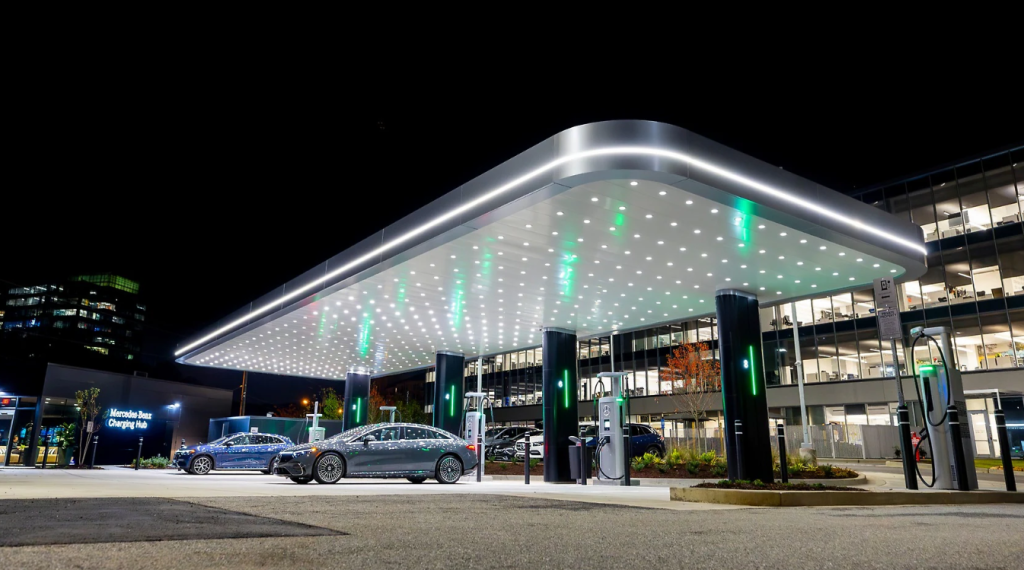
At EV SPOTS as well, we plan to develop such a hub, to transform charging into a complete and different experience.
But in Romania, the market is in its infancy, although we have a good adoption rate. We still have a lot to grow. And this is not just happening here, although the trend may be more pronounced here.
According to Electrify News, 80% of EV drivers choose to charge their car at home. In the US, 83% of EV owners charge at home, saving a lot of money. And in Europe, the percentages are similar.
How long does it take to charge an electric car?
The charging time of an electric car is not a fixed thing. It depends on several factors, including:
- capacity and charge level, as well as battery status
- the charging power offered by the station
To somehow estimate the charging time of an electric car, it’s easiest to use the formula:
☑️Duration = Battery Capacity ÷ Station Power
Calculation examples
- If you charge at home, at a 7kW outlet, and your car has a 60kWh battery -> you will most likely wait approx. 8 – 9 hours.
- If you charge at a 22kW station, while, say, you’re out with your family at the mall, you’ll be able to spend about 3 hours shopping before you fully charge.
- If you arrive at a 50kW fast charging station, you will be on your way in approx. 1 – 1.2h
- And if you choose to charge at a 180kW station, you’ll be ready to go in less than half an hour.
You also need to consider that you never leave with a 0% battery. You will most likely gain a few more minutes by arriving at the station with 10-15% autonomy (it is not recommended to let the battery drop below 10%).
The loading speed is not constant
🧠 The difference between 10–80% vs 0–100%
Between 10% and 80%, the car receives energy the fastest. After the battery is 80% charged, protection systems slow down the process to extend the battery’s life. Charging from 80% to 100% will be much slower.
A concrete example is the Hyundai Ioniq 5 with a long-range battery. This crossover can be quickly charged at a DC station, going from 10 to 80% in just 18 to 20 minutes. But it takes another 32 minutes to go from 80 to 100% – almost double the time it took to go from 10 to 80.
An electric vehicle with a range of 480 km can provide approximately 385 km of range at 80% charge. The time you spend waiting to reach 100% could instead be used to drive another 100 km and locate another charging station.
Many vehicles now include infotainment system settings to help you charge efficiently. There are also mobile apps that allow you to set a maximum charge level each time. But until then, we have 2 recommendations for you.
🔋 Recommendation: for maximum efficiency, but also to extend battery life, stop charging at ~80%, especially when charging at DC fast charging stations.
🔋 Recommendation 2: Alternate charging methods over time. Charge your car at both AC and DC stations.

Of course, there are some exceptions, when you might need a full charge:
- when it’s winter and you expect to have lower autonomy – and autonomy is lower in winter and charging will take longer in extreme conditions
- when you have more weight in the car
- when you go on very long trips
- or if there are manufacturer recommendations (some RWD vehicles recommend full charging)* according to EV.COM
How much does it cost to charge an electric car?
A 1000 point question!
And the answer is straightforward: IT DEPENDS!
It depends on where you charge (whether it’s at home or at the office or at public stations), it depends on the type of charging (whether you charge slowly or fast) and many other factors.
However, one of the biggest advantages of electric vehicles is the low cost of fuel. Thanks to the high efficiency of electric motors (which convert over 70% of electrical energy into motion*), fuel consumption per 100km is significantly lower compared to petrol or diesel cars.
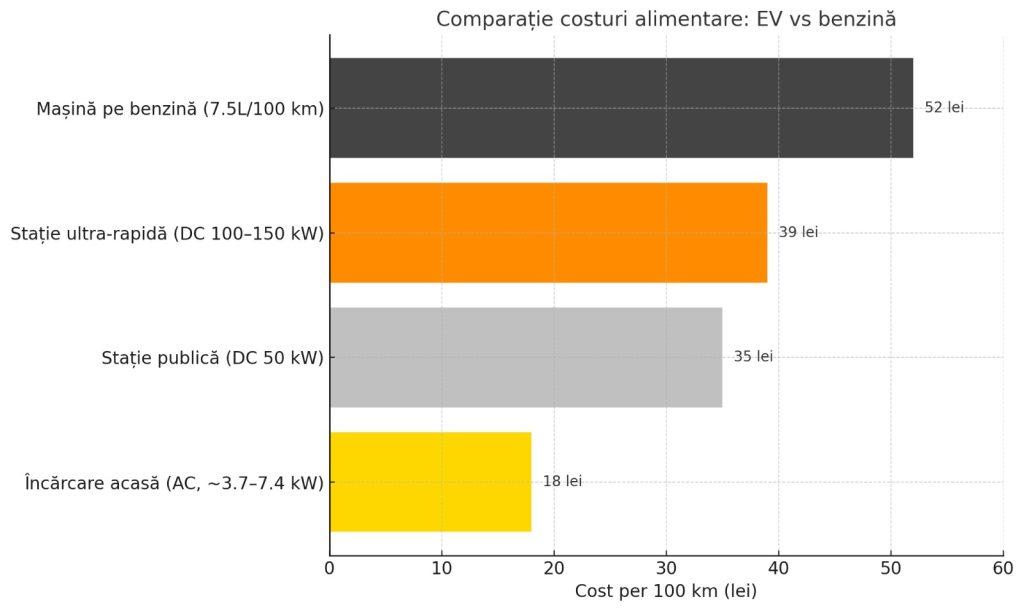
For example, in Romania, an EV with a consumption of 15 kWh/100 km can travel this distance for a cost between 18 – 39 RON depending on the type of charging. By comparison, a classic car with a consumption of 7.5 l/100 km could cost you approximately 50 RON or even more for the same distance.
In the long run, these savings add up, and if we also take into account the cost advantages (through subsidies granted under the RABLA program) + tax exemptions, an EV ends up being much more advantageous in terms of reduced costs.
Electric car charging prices in the EV SPOTS network
If you choose the EV SPOTS network to charge your electric car, you also benefit from other advantages. For example, if you have the mobile app downloaded and have an account, you benefit from a discount of 0.5 RON / kW compared to the prices displayed at the station. Plus, you have the opportunity to frequently win gift credits for charging, as part of our promotional campaigns.
The price for charging on the EV SPOTS network differs depending on the type of charging chosen:
- for slow charging – AC – 1,77 lei / kWh
- for fast charging – DC – 2,59 lei / kWh
Of course, you can also choose ultra-fast charging, to “fill up” in the blink of an eye, if you don’t have much time. For more details on pricing, you can also access our pricing section.
How do you plan to charge your electric car for a worry-free trip?
Charging an EV doesn’t have to be as stressful as many people make it out to be. With a little advance planning and organization, you can travel anywhere, anytime, avoiding the stressful situations of worrying about where and how to charge.
You can say goodbye to the situation where you can’t find a place at the stations, pay more than you need to, or run out of battery. That’s if you become a little friend with apps like PlugShare. If you start making a travel itinerary, a schedule, a route planning, before you hit the road.
Some tips on planning your EV charging from our experience
🔋 Overnight charging – your best ally
If you have the option to charge at home, schedule charging during the night (10:00 PM – 6:00 AM), when energy rates can be much lower. ElectricUP shows that by optimizing your consumption according to the period, you can save up to 30% on charging costs.
🧭 Long-distance route planning – your EV can tell you where to stop
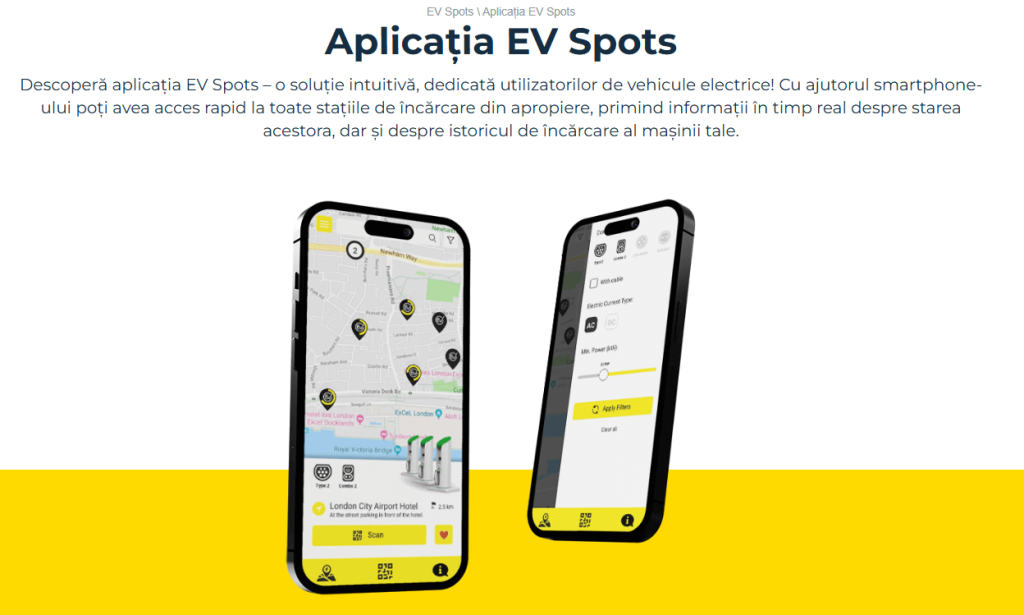
For longer trips, plan your route using specialized apps, like PlugShare. You can even use the station map in the EV SPOTS app.
Choose to make stops based on battery level and station power (ideal: 20–80% battery for a quick charge).
Check in the app if the station is operational, if it is busy or if it has more sockets available. And see how busy the sockets are. In addition, the EV SPOTS app allows you to reserve a charging socket 15 minutes before you arrive, to make sure you don’t stand in line.
🏙 Charging in the city vs outside the city
In the city: opt for slow charging (AC), in the parking lots of malls, supermarkets or in parking lots, where the rate is lower. And use the waiting time to do some work. If you come to the mall and know that you will spend the day shopping, on the terraces, relaxing with your family or even watching a movie at the cinema, it is a perfect situation to leave your car charging all this time.
On the highway or out of town: look for fast (DC 50kW) or ultra-fast (DC 180kW+) stations to reduce your downtime. While charging, you can quickly reply to an email, schedule a meeting, or talk on the phone. You can also take a short coffee break. Most of the time, being on the road, on a long journey, you will stop anyway to rest your legs, take a toilet break, or have a snack. Plan your routes in such a way that you have the option to fast charge throughout this time.
✅ Other practical tips for a stress-free experience
- When going on a long trip, start with at least 80% battery. Ideally, you should charge fully when traveling 500km+.
- avoid letting your battery discharge below 10% – efficiency drops significantly and all kinds of unforeseen situations can arise – busy or non-functional stations – so you will always need to have a back-up that allows you to move in such cases.
- if you still have to wait at the station, use charging networks that offer you options to spend your time in a pleasant and useful way – coffee break, meal – internet access, relaxation or entertainment spaces – most EV SPOTS locations are designed precisely in this direction.
- learn the type of connector you need – using the EV SPOTS app you can also activate the autocharge function – memorize your favorite connector and the second time you arrive at the station, charging will start automatically.
What happens if I run out of battery?
- Never panic if you have 5% or less battery left. You can activate “eco mode” to maximize fuel efficiency, and the car will warn you frequently to avoid this situation. Similar to an internal combustion vehicle, the dashboard will display warning lights + the car will enter “tortoise mode”. This is a feature specific to electric vehicles and is designed to prevent the vehicle from suddenly stopping and leaving the driver in the middle of the road.
Once activated, turtle mode reduces the vehicle’s power and speed, restricting battery power, allowing you to safely stop or slowly drive to a nearby charging station. Our advice is to stop immediately when turtle mode is activated and have a contingency plan, check your map, calculate the distance to the nearest charging point, and avoid aggressive driving at all costs.
Emotions don’t help you at this point, but awareness and rational thinking do!
Download the EV SPOTS app and discover premium locations, where while charging you have time to do your chores or spend your time in a relaxing way, combining business with pleasure.
Charging in winter – autonomy, efficiency, useful tricks, myths and more
We could make a separate guide just for this section. With so much discussion about this topic and so many myths that have formed around it, it’s very important to define once and for all what is relevant and what is not.
How winter influences range, how the EV performs in terms of efficiency, but also how you can compensate for losses and optimize the driving experience… and much more.
How do low temperatures affect the charging process of electric cars and the level of autonomy?
It is a known fact that in winter, autonomy decreases. Why does this happen? Low temperatures affect the chemistry of the battery, simply explained. Specifically, to create the electricity used to power the engine, the lithium ions in the battery move from the negative to the positive side of the battery (from the cathode to the anode). In cold weather, this chemical reaction is slower. And this makes the battery less efficient. So, it has less autonomy.
This doesn’t just happen in winter, though. It’s the same in extreme heat. The easiest way to prove this to yourself is to try it with your phone. Try using your smartphone after leaving it in the sun for a few hours. You’ll see the difference in performance. It’s exactly the same with an electric car, but on a much larger scale.
In addition, the car is much more demanding in the winter due to the heating systems. Thus, the pressure on the battery is greater. Energy consumption is also higher.
How much autonomy is actually lost?
Studies, according to Consumer Reports, show that once we reach temperatures close to freezing, the impact of cold weather on the autonomy of an electric car is approximately 20 – 25%. This impact begins to be felt at temperatures as low as 4 – 5 degrees Celsius.
This means that a car with a range of 320 km on a normal day is more likely to travel a maximum of 270 – 260 km on a frosty winter day.
However, this also depends on the type of trip. Consumer Reports tests also show that short-distance trips in freezing conditions, with frequent stops and requiring reheating of the cabin after parking breaks, can reduce range by up to 50%.
Fortunately, there are things we can do to mitigate the effects of this decline. And you don’t have to worry or carry a heater around with you when you plan to hit the road with an EV in the winter.
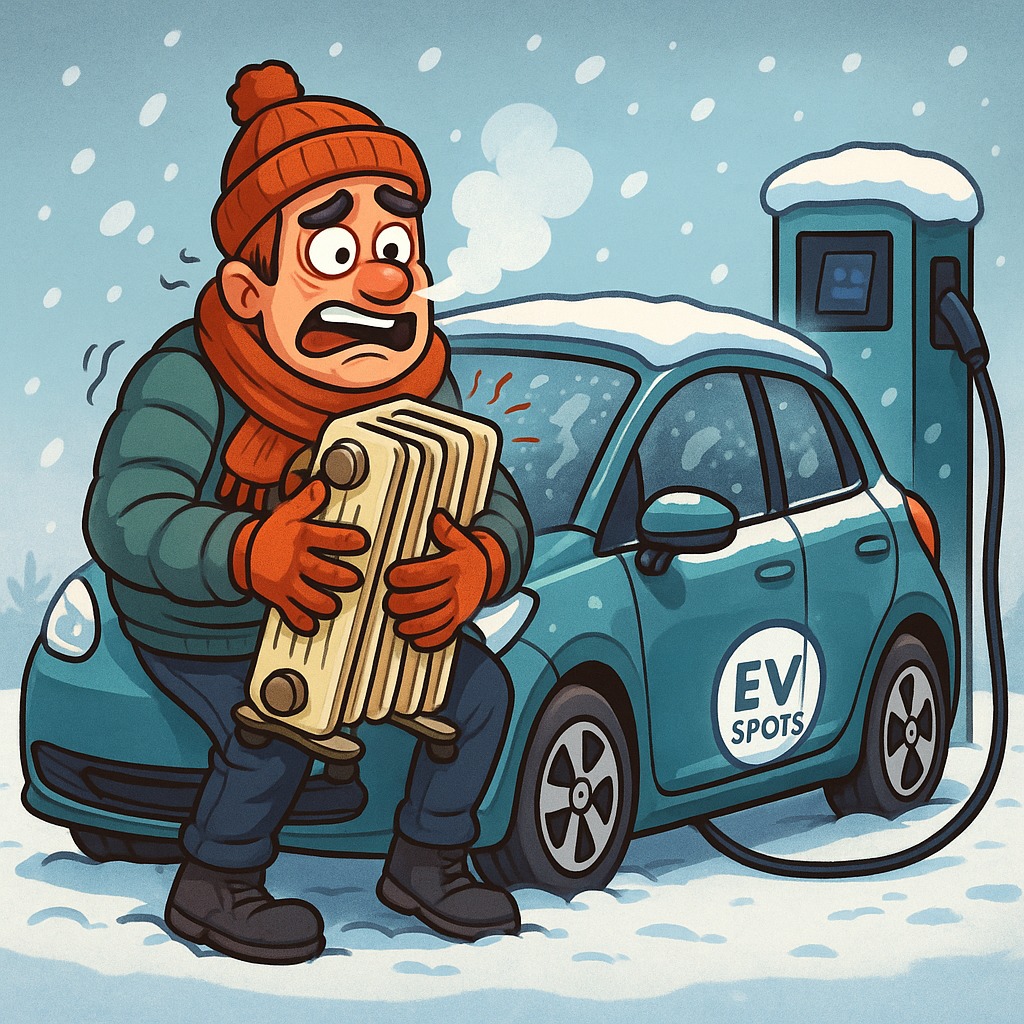
Tips on charging your electric car in winter
You can’t change the weather, but you can make some choices about how you use your electric car in the winter to make it more efficient. Here’s what you can do!
5 tips on charging your electric car
- Pre-conditioning the battery when connected to the charger – if you know you’re leaving at 9am, you can alert your car to automatically warm up the cabin beforehand. To do this, most cars allow you to set an itinerary, either via the vehicle’s infotainment screen or a mobile app.
- Choose an EV with a heat pump – heat pumps are available as standard, or sometimes optional, on many new electric cars. They work in the opposite way to a regular refrigerator. They take in cold air from outside, compress it to high pressure, and release the heat created. The advantage is that they do this much more efficiently than a regular heating system.
- Use heated seats and steering wheel – don’t just turn on the heater if you’re cold. Instead, try heating the seats and steering wheel. The cold is felt worst in your extremities. Warming your hands and feet will make you feel much better. The advantage here is that heated seats and steering wheel systems use much less energy than heating the entire cabin.
- Switching the car to Eco mode will maximize range and offset much of the impact of the cold. Regenerative braking can also help increase range if you drive responsibly.
- Leave your car plugged in when not in use. Especially if you charge at home or at the office (on AC charging). The battery will stay warm, absorbing a small amount of energy during cold winter nights.
Winter test between 3 cars – for preconditioning setting
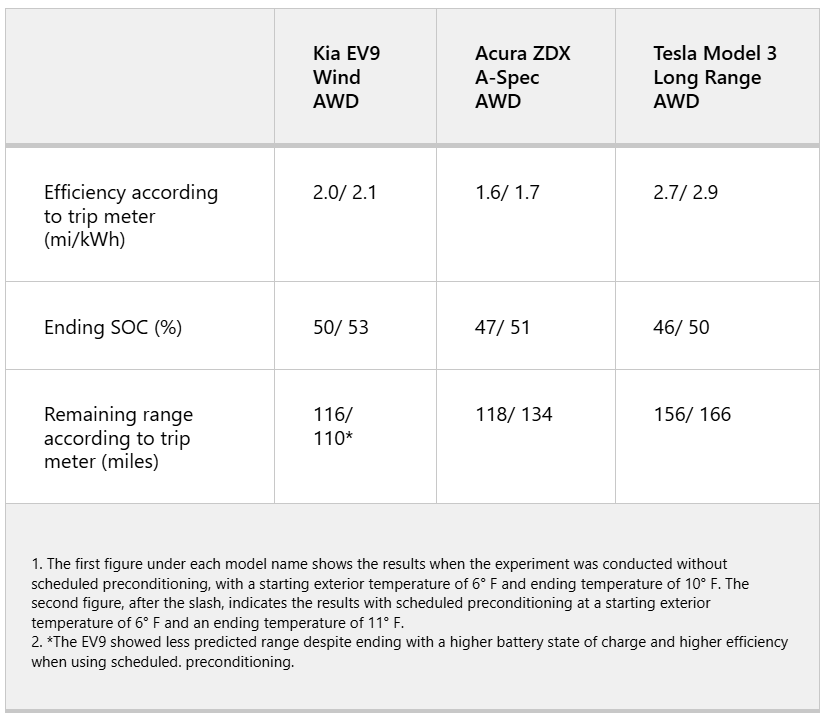
Consumer Reports conducted a test. They compared the results of 3 cars, under identical conditions, on a winter route.
Over two days in January 2025, with temperatures below 10 degrees Celsius, they drove a 2024 Kia EV9 Wind, a 2024 Acura ZDX A-Spec, and a 2024 Tesla Model 3 Long Range on a 100-mile highway loop. And they recorded the difference in efficiency, remaining charge, and estimated range for the three vehicles. They did this both with and without the use of preconditioning, heating the cabin to 72° F.
The EV9 and ZDX showed a 5% and 6% increase in efficiency. Then another 3% and 4% in battery charge, respectively, when using the preconditioning setting. Similarly, the Model 3 saw a 7% increase in efficiency. And it ended the test with +4% remaining battery power. Mysteriously, the EV9 showed a lower range prediction at the end of the driving loop. Despite being more efficient when preconditioned. But the ZDX and Model 3 predicted an additional range of 26 and 16 kilometers, respectively, validating the test overall.
“The differences may seem drastic in this case, but this is typically a ‘set it and forget it’ feature in most electric vehicles, with little to no downside,” says Alex Knizek, manager of automotive testing and analysis at Consumer Reports.
Winter test between 3 cars – for central heating vs. heated seats and steering wheel
Also at Consumer Reports, this efficiency method was tested, at freezing temperatures (between -2°C and 0°C), using 3 different electric vehicles: a 2023 Nissan Ariya Platinum+ AWD, a 2023 Lexus RZ 450e Premium, and a 2022 Kia EV6 Wind AWD.
Following the tests, they recorded the difference in efficiency and the remaining battery charge level depending on the car, along with the energy required to recharge each car to 100%.
For the first test, they set the automatic climate control systems to 22°C. For the second test, the climate control system was turned off and only the heated seats and steering wheel were used. They drove a 210 km round trip, mostly on the motorway. The cars showed a 7 to 8% higher efficiency with the climate control system off, which is notable.
However, the test drivers commented that the test was quite uncomfortable. It was cold inside the car and if it weren’t for science, they would have turned the air conditioning back on. So the test was confirmed, but the choice is yours! Depending on how comfortable you feel, you can accept the reduction in range and drive with the heating on. Or you can save money and turn off the heating, driving with only the heated seats and steering wheel.
This might be worth it in an emergency, but it’s not recommended to abuse this technique just to save money. But, you decide!
Frequently asked questions about the electric car charging process
Owning and charging an electric car brings with it a host of questions. Many drivers worry when they make the leap to EV that they won’t be able to handle it. Let’s take a look at 10 of the most common questions and answer them to shed some light on the subject.
1. Can I charge at any station, regardless of the brand of car?
Generally, yes! As long as your car is compatible with the type of connector at the station (and most are). For example, we, at EV SPOTS, have stations with 3 different types of connectors, to give every driver the chance to charge. We have all 3 standards: European, Asian + AC charging standard. We also have the standard DC charging connector (CCS2) and the fast charging connector for import cars (CHAdeMO) and the charging connector for AC Type 2.
2. Do I need my own cable to charge?
At our stations you don’t need your own cable, as both AC and DC charging have connectors integrated into the station. However, it is possible that at some sockets or wallboxes, for AC charging, you will need your own cable.
3. How do I find the stations and how do I know if they are available?
It is precisely for such situations that we have designed the EV SPOTS mobile application. You can download it for free from the App Store or Google Play, create an account and have all the information about the stations available. You will see where they are located, if they are busy, if they are working and many other relevant information. In addition, you also have the charging history, the payment history and you can get an invoice for the charges made. And if you have an account in the app, you pay 50 bani less per kW. If you choose to charge with other operators, you will have to download their applications or check the station on specialized sites, such as PlugShare.
4. Can I charge the car with a normal outlet?
Although it is not recommended, due to the high load placed on the installation, you can do this. However, charging will take over 12 hours, most of the time. The safest and most efficient is to install a wallbox, if you want to charge at home.
5. What happens if I leave the car at the station after charging?
In addition to blocking the station for someone who really needs to charge (imagine what it would be like if you were also blocked when your battery ran out and someone left their car parked at the station, so you couldn’t charge), some providers may apply penalties for occupying the station abusively.
6. How do I know how much energy I have consumed and how much I have to pay?
When you have our app, you will see in the app after each charging session how much you have consumed and how much you have paid. The app also keeps a detailed charging history, where you will find all the necessary information.
7. How do I pay for charging?
In the app you will have the option to create a digital wallet to add money to and pay directly from the app. The biggest advantage of such a wallet is that we run frequent promotions, where we offer gift credits based on the amount you load into your wallet. If you load money into your digital wallet in the app, you will receive more money as a gift from us, so you can cover a few loads right from these gift credits.
8. Do I need to have an account in the EV SPOTS app to be able to charge my car?
It’s not necessary, but it’s recommended. You have at least 2 big advantages if you have the app. One is that you will have real-time information about all the stations and a detailed history of all your charges. And the second is that you pay less than the displayed price + you also have these promotions that we discussed above. However, you can get to the stations and charge even if you don’t have an account in the app, you just have to pay more.
9. What happens if I run out of battery before I reach the station?
As I mentioned throughout the article, your car will warn you when it reaches a critical battery level. It will activate its “turtle” mode and help you slow down, conserve energy, until you find a solution. Unfortunately, if you run out of battery completely, by the time you get to the station, your car will stop. It’s exactly like when your phone turns off. The car will basically shut down and it will be impossible for you to move.
10. Should I always charge the battery to 100% to be safe?
It is not recommended by manufacturers to charge to 100% every time. It is best to keep your battery between 20% and 80% and only use full charges when preparing for a long trip or in extreme weather conditions. This will help extend the life of your electric car battery.
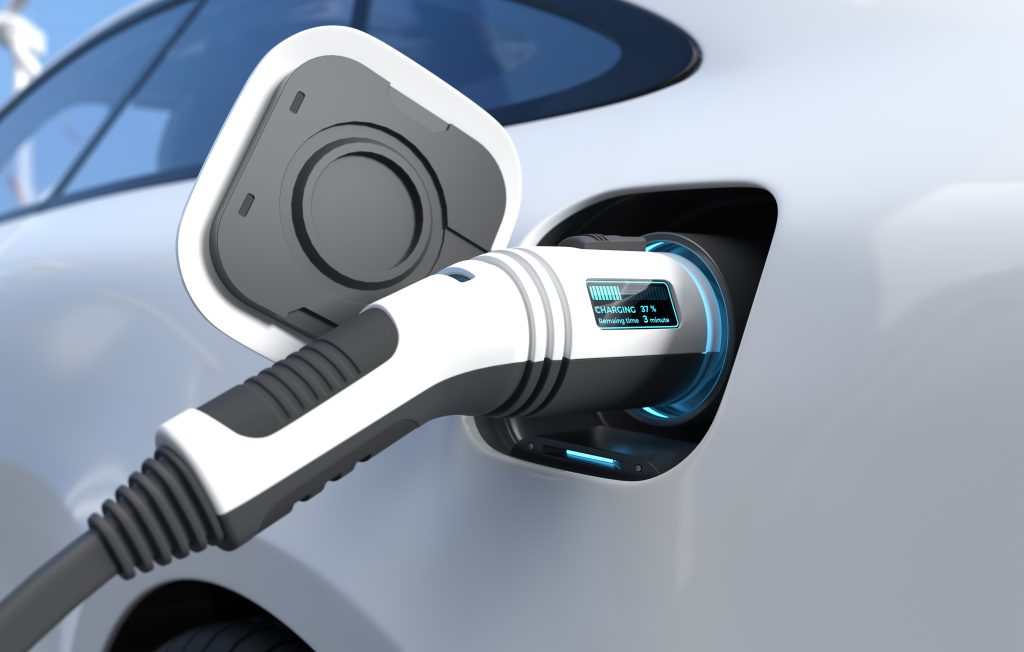
Charging becomes easy if you know what you’re doing – follow us for even more tips and useful information!
If you’ve made it this far and read carefully, it means you’ve already done your homework. You’re much more prepared than other drivers to take the step towards driving green. Of course, you can always learn more by following our blog.
Here you also have a complete guide on how an electric car works. And on the blog you can find lots of other resources and news.
We talked about the differences between AC and DC, charging types, costs, waiting times and how to make the most of your electric car charging and driving experience. You’ve seen the calculations, the tests, the studies and you’ve also read our advice.
The transition to electric doesn’t have to be complicated. With accurate and up-to-date information and a trusted partner, everything becomes simpler.
Now it’s your turn!
✅ Download the EV SPOTS app
📍 Explore the map with all the stations in the network
💬 If you have any questions, write to us here or contact us in the call center – our team is here for you
📲 Follow us on social media for news, debunked myths and useful tips
📌 And last but not least, save this guide and send it to any friend or anyone who wants to switch to electric. It will definitely be useful.